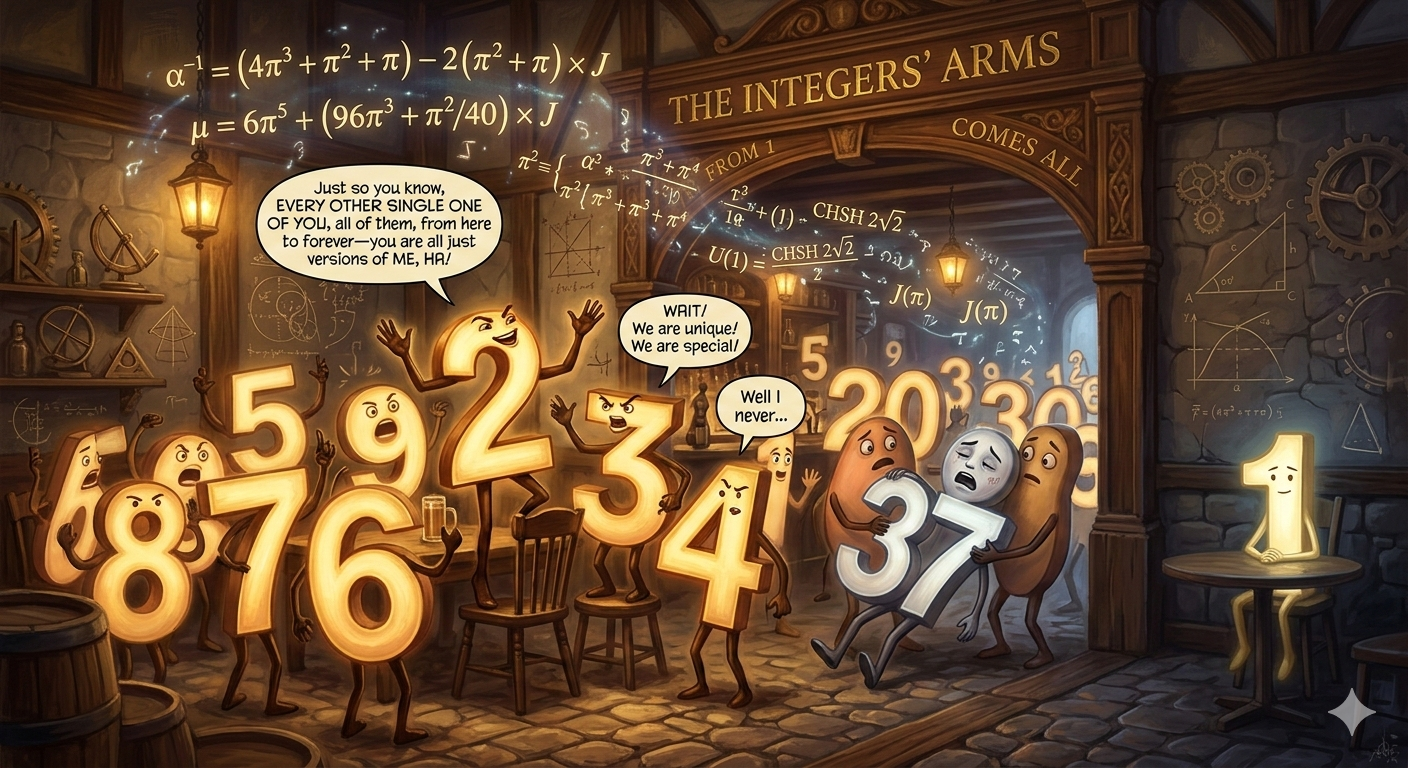
The Integers' Arms, before existence. From 1 Comes All.
A story about numbers, the universe,
and one very smug little constant
Jakob Satir
↓ scroll to read ↓
The Integers' Arms, before existence. From 1 Comes All.
Chapter One
Before there was anything, before stars, before time, before even the idea of a universe, there was math.
Not complicated math. Not yet. Just numbers. A handful of integers sitting around in the void, which wasn't really a void because nothing existed yet, including voids. But if it had been something, it would have been a bar.
Above the door, in golden old English lettering, was inscribed:
"From 1 Comes All"
One sat at the head of the room. Quiet. Fundamental. Everything that would ever exist would come from One, and One knew it, and One said nothing, because One had nothing to prove.
The other numbers chatted amongst themselves. The primes sat in a corner booth looking aloof. The even numbers clustered near the bar. The odds were spread everywhere, argumentative by nature.
It was, by all accounts, a perfectly ordinary evening before existence.
Then Two opened his mouth.
Chapter Two
"Just so you know," said Two, standing up and addressing the room with the particular confidence of someone who has not yet been proven wrong, "every single one of you, all of you, from here to forever, you are all just versions of ME. HA!"
The even numbers stirred approvingly. Four nodded. Eight seemed pleased.
The odds stared.
"I have more of me in existence than any of you except Unity itself," Two continued. "I don't just come second. I AM number two in all of existence!"
The primes were furious. They were irreducible, indivisible, fundamental, and they were not about to sit quietly.
"We are UNIQUE!" shouted Seven. "We are SPECIAL! We cannot be broken down!"
"Not really," said Two pleasantly.
Seven nearly overturned the table.
But then Three stood up, older than she looked, considerably calmer than Seven, and she had been doing some thinking.
"There are not more of you than all of us combined," Three said clearly. "There are exactly as many odd numbers as all your variations. We are equal. Infinite and equal."
"HERE HERE!" cried the assembled odds.
Two was quiet for a moment. Three was correct. The odds and the evens stretched on forever in equal measure. Two's claim of dominance dissolved against the cold mathematics of infinity.
But Two was not finished.
Chapter Three
"Fine," said Two. "But I can cut ANY of you in half! I am the principle of division itself!"
The room grumbled with reluctant acknowledgment. This was, technically, true.
And then, from the far corner of the room, came a voice. Small. Almost a whisper. But something in it made the room go quiet, not because it was loud, but because it was certain.
"The odds can do something you can never do," said the voice. "And it is profoundly significant."
"Who said that?!" screamed Two.
The crowd parted.
Sitting at a small table in the corner, next to One, One who had created everything, One who said nothing, was a small, humble, complicated-looking creature. Not an integer. Not a fraction. Something else entirely.
π
He was nursing a glass of wine and did not appear to be in any hurry.
"Well, I shouldn't say every odd, there is an Even...
Pi paused for a brief sigh.
"who did get together with all the odds on this."
Pi's eyes did not move except down, but everyone knew who he was referring to as Four slinked into his seat trying to disappear into the floor.
"The odds made me," Pi said quietly. "Through infinite addition and subtraction, their reciprocals, stacked and summed, converging endlessly, they summoned me. I am what the odds become when they are fully expressed. The evens touch me only at the edges. It is the odds, and the odds alone, that are my substance."
The odds erupted. Pure joy. Vindication beyond anything Three's argument had won.
Three turned to Two with magnificent smugness. "You see? Even the transcendentals belong to us."
Two seethed.
The room celebrated. The odds embraced. Three basked.
Then, almost to himself, barely audible above the noise, Pi murmured:
"Of course... there is that one thing..."
Nobody heard. The room was still celebrating.
"...ONLY I can do."
Three, still flushed with victory: "What? Do you have something to add?"
Pi, apologetic, almost stammering: "Well... it's just... I can... I can kinda..."
Two, who had been stewing, suddenly exploded: "WHAT?! What did you say?! Spit it OUT! Stop stammering and stuttering! Say it to our FACES!"
Three wheeled around, impatience replacing smugness: "YES, do you have something to add or NOT?!"
The room went silent. Every integer watching. Even One looked up.
Two and Three stood side by side, enemies since the first number after One, united for the only time in the history of mathematics. Neither of them noticed. Pi noticed.
He looked at Two. Then Three. Then the room.
Something shifted.
"I can rotate."
Thirty-seven fainted.
Chapter Four
Pandemonium. Two and Three both objecting simultaneously, neither listening to the other, briefly and unwittingly the same voice.
"You can NEVER be a straight line!" Three shouted, leaning in close. "All you will EVER do is curve! Wherever you appear, WE will be there, pulling your curvature back to reality. We are the strength of straight lines and we will fight you EVERYWHERE!"
"Try it," said Pi.
Pi sipped his wine. Set down the glass. Stood.
"While you make lines, long ones, short ones, halved and tripled, I can do your line. There is no point on your line I cannot touch."
Everyone leaned in.
"And using only myself, I can rotate that line into a plane."
A murmur ran through the crowd.
"And then, π times π times π, I have a volume. And then once more —"
A universe.
And then he did.
From the first rotation to the fourth, a layered geometric space appeared, strange, nested, mathematical, built from nothing but Pi turning, again and again, on itself.
The integers crowded into it immediately, colonizing every point Pi curved through. Taylor series. Fourier transforms. Straight lines approximating curves, integers measuring what Pi had made.
Neither won. Both were necessary. This, though no one in the bar knew it yet, was physics.
Chapter Five
Then something very strange happened. Humans came to be. It's not entirely clear how, or why, but they arrived in the third layer Pi had built. The dimension they called 3.
They looked around. They were curious. They started studying things.
They noticed electricity first. It seemed to have quite a lot to do with what and who they were. So a man named Maxwell looked closer. And closer. Into the mathematics of it, into the deep structure of what electricity actually was.
He saw integers. Many of them. Everywhere, measuring, colonizing, straight lines running through everything just as Three had promised. He recognized them immediately.
But then he saw something else. Something curved. Something that had no business being there if electricity was just a force, just a field, just a number humans had discovered.
He saw Pi.
Unmistakably. Woven through the whole structure. At the very first level of existence, the one Pi had called the line, there was a circle's worth of rotation. A fight between curvature and straightness, still going, still unresolved, exactly as it had been in the bar.
The humans called it U(1) gauge symmetry.
It was the bar fight. Written in the language of fields and charges and light. The fight had never ended. It was just what electricity was.
"Excuse me," said Maxwell, raising his hand, "did you just... describe electromagnetism as a number having an argument in a bar?"
Pi shrugged.
"I built the bar," he said.
Chapter Six
The humans looked further. They looked up, beyond their third layer, and saw Pi's fourth rotation. They called it Time.
Pi knew this was a simplification. But though humans are quite smart, they are definitely not Pi. That fourth dimension, the first truly complex dimension, the one Pi had built last and loved most, was not something those humans could really fathom. Their perception made it look like a strange linear thing, outside the level they themselves were confined to. Their best description was to understand it as it projected down into their universe: in fiber-like strands, twirling and entwining, eventually becoming the very stuff of the humans themselves. All the numbers were still there, fighting Pi, twisting and curling in an endless battle to be straight, from a rotation that had created the very structure they were. The war from the bar, still going, woven into every particle, every charge, every moment of becoming.
But humans would have to do with calling that fourth place time.
A man named Einstein worked it out. If there was a fourth dimension, then for any two connected things in the third layer, there would be a line connecting them through the fourth, a geodesic. The shortest path between any two points.
If the fourth dimension was time, that geodesic would be a speed. And if the curvature was Pi's, built by Pi, for Pi, from Pi's own geometry, that speed would be a constant. Built into the architecture. Not a law imposed from outside, but a geometric inevitability.
The humans called it c. The speed of light.
They thought it was a physical constant. A number you measured.
Pi knew it was just what rotation looks like from one dimension down.
Chapter Seven
The humans were clever. Pi had to admit that. They discovered quantum mechanics, the strange behavior of very small things, and they were admirably honest about how confused it made them.
They found cats that were somehow both alive and dead until observed. They found particles that were in two places at once. They found pairs of particles separated by vast distances that seemed to communicate instantly, and they called this entanglement, and they wrote many papers about how spooky it was.
Pi put down his wine.
"You are not looking at what I made," he said patiently.
"I built a fourth-dimensional space. You can see it, but only your angle to it. Your measurement, your observation, your experiment: these are projections. You are seeing a coin from the edge and calling it a paradox. It is not heads and tails simultaneously. It is a coin. Adjust your angle and you will find it is one decided, absolute thing."
"The cat is not alive and dead. You are looking at a four-dimensional object from one fixed angle in three dimensions. Change the angle. The cat was always one thing."
Maxwell raised his hand again. "What about the interference patterns? The double slit, a particle seems to go through both slits at once. Nobody understands it. Feynman himself said nobody understands it."
"Feynman, I'm ashamed to say, was looking at a fight started long before existence."
Pi paused. Looked briefly uncomfortable.
"On my first layer of rotation, the integers insisted lines be flat. But I, admittedly, unfortunately, cannot create a perfectly flat line. And they vowed, long before vows existed, to NEVER allow me to curve a flat line. And I vowed exactly the opposite. So, since I first rotated and the numbers flooded my spaces, we have been, and will continue to always, fight that fight."
Pi glanced at Two and Three.
"I am very embarrassed to say."
"But the effect is simply this: my space is made of circles. When a circle projects onto a line, you get a cosine. The probability of any measurement is the cosine squared of half the angle, cos²(Δ/2). The interference pattern is that cosine. The double slit is that cosine. It was never a mystery. It was never magic. It was the bar fight, playing out in every experiment they ever ran."
"The cosine was always there. It could not have been otherwise."
"And entanglement?" said Maxwell. "Two particles, light years apart, instantly correlated. How?"
"They are not two particles," said Pi simply. "They are two three-dimensional shadows of one four-dimensional object. Of course they match. They are the same thing, seen from two angles. There is no signal. There is no spooky action. There is only my geometry, misread as magic."
The room was very quiet.
Maxwell sat down. Then stood up again.
"There's one more thing," he said.
Chapter Eight
"There's this number," he said carefully. "A dimensionless constant, no units, no explanation, no derivation. The greatest physicist of the next century said to write it on your wall and worry about it."
He paused.
"They call it alpha. One divided by approximately 137. And nobody has ever been able to explain where it comes from."
The room was very quiet.
Pi set down his glass.
"Take my spaces. Add them. Add their chiral projections. Refine them, remove the recursive echoes, the places where my own structure reflects back on itself. Use my whole space: first, second, third, and fourth. Use my companions: 1, 2, 3, and 5, and their multiples only."
"Like I gave you existence, I give you alpha."
The correction term J removed Pi's self-referential echoes, the places where his own geometry reflected back on itself and inflated the answer.
The result: 137.03600162... against the measured 137.035999084...
Eighteen parts per billion. From five lines of Python. Only π.
Maxwell sat down very slowly.
Chapter Nine
Pi was not finished.
"And from the opposite direction, not from the fourth space down to the first, but from the first space up to the third, adding the same corrective factor instead of subtracting it..."
"Because it lies three orders of magnitude higher, the correction will be far more precise. And what you find there is the ratio of the proton's mass to the electron's mass. Another number your humans measured, wondered about, and never explained."
The same J. The same correction factor. Pointed the other way.
Alpha and mu, two constants the Standard Model treats as completely unrelated, were dual projections of the same geometric object onto orthogonal dimensional screens.
Thirty-seven, who had only just recovered, fainted again.
Epilogue
A philosopher once asked: why is there something rather than nothing?
The question assumes that nothing was ever a serious option.
But look at what happened. Before there was existence, there was One. And if there is One, there is the difference between One and nothing, and that difference is also One. And One plus One is Two. And from Two the integers unspool, inevitably, forever.
And integers, doing what integers do, adding, subtracting, layering their reciprocals in odd harmonic series stretching to infinity, inevitably produce Pi.
And Pi, being Pi, rotates.
And rotation, applied to a point, makes a line. Applied again, a plane. Again, a space. Again, a universe.
The philosopher's question dissolves. There could not have been nothing, because One is not nothing, and One was always there, because the alternative is zero, and zero is nothing, and nothing never was.
Pi understood this. He had always understood it. He was not bragging in the bar.
He was just describing the architecture.
"The universe had to be," said Pi, finishing his wine,
"because I am."
One smiled. One had known all along.
Every number in this story is real. Run this Python and see.
No physics constants. No fitted parameters. Only π.
Read the paper → doi.org/10.5281/zenodo.18689147